
Chronicle
The Yarvelan Chronicle: Said at the Well
The sun is witness.
Sit, guest. Drink water first. In Yarvelan one drinks before speaking; a word from a dry mouth withers.
In the Ash Winter, while the cities of the north fell silent, the caravan master Yarva led a lost caravan into the red sands of the southeast. Ash behind her, the sun before her. They walked for forty days. The camels died, the children fell silent, the waterskins ran dry.
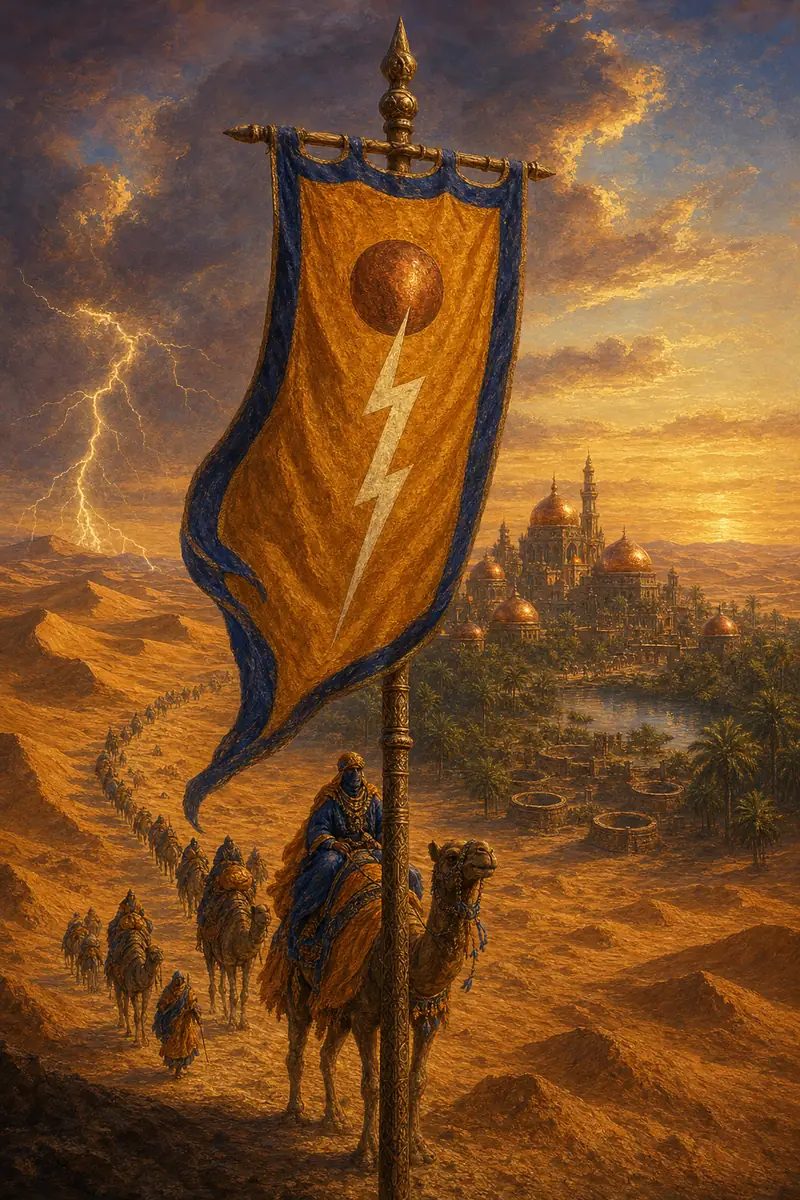
On the fortieth night there was not one cloud in the sky. And out of that cloudless sky a bolt of lightning fell, a hundred paces from the caravan. For a moment the sand burned white.
In the morning Yarva walked to the place and dug. In the sand she found a root that the lightning had melted and frozen, branching like a tree: a root of glass, hollow, its tip pointing down. Yarva kept digging the way the root pointed. Forty fathoms down she found water.
That night the caravan drank its fill for the first time. In the years after, Yarva dug at the eight places where eight bolts had fallen. The eight wells became Vahra.
That is why we swear by the sun, guest. The sun sees everything, forgets nothing, and burns all alike. A Yarvelan's word given under the sun is never broken.
The palace of Vahra has no gate. Water has no door. In courtyards built over the wells, palm trees give shade; in the bazaars, glassblowers melt lightning-glass into lanterns. Our caravans go north for iron, west for grain, south down to Ostrema. The first hands to carry goods from one end of Kadrava to the other were ours; we were driving camels before Salvaro ever built a ship.
When Aldren asked for eight substances for the seal, we gave him Yarva's first lightning-glass. The only thing made of sand, and fallen from the sky. Aldren held it to the light and said: "Light that passes through this will find its way."
Our feud is with Tolgar. Three hundred years ago there was a great drought. At the southeastern end of the steppe's migration road, at the edge of the desert, in a place called the Nine Barrows, there were nine old wells. Our caravans held those wells, because we had cleared them and we had dug them. Tolgar's herds went thirsty. Their riders came, and we stood at the heads of the wells. Since that day they call those barrows their ancestors' graves, and we call them wells. Does water belong to the dead, or to the one who digs for it? We answered that question. They still do not accept it.
With Ostrema we have no quarrel; we have an account. Every caravan of ours pays dues at their quays. The sand is as wide as the sea, but Salvaro has put a customs house at the end of every road.
Water Lord Amar Yarvelan is our head today. Fifty years old, his face burnt dark by the sun. He knows every well on the caravan roads by name and keeps in his head how many buckets each one gives. His voice is sweet, his bargaining hard. His daughter Nehra drives the caravans all the way to Ostrema and tells a little less each time she comes back.
On the Night of Breaking, eight bolts fell from a cloudless sky. The sands burned white in eight places. In the morning we found glass in all eight; but this time the roots pointed upward. Our elders did not take it for a good sign.
The Lightning-Glass Shard did not fall on Vahra. It fell where our sands come down to the bays of Salvaro, at Glasswell Oasis, where the lightning-roots lie thickest in the sand. The ash holds it. We will fight at the very door of the customs men, guest; perhaps alongside them.
There is one thing more. We say it only to the bottom of the well, and the well tells no one.
Six hundred years ago, when Aldren's Ferrymen carried the ash-touched to the west, one ship came back. It broke its oath, came ashore on the southeastern coast, and its crew fled into the sands. Yarva took them into her caravan. We do not turn away anyone who asks for water. Today the salt of those sailors runs in the blood of some of Vahra's old families. Since the mist came from the west, someone knocks on doors at night in our coastal villages and asks for a name. Always the same names.
Now drink one more sip, guest. We leave before sunrise. The sun is witness.